The Scenario
You have been asked to investigate whether the use of prophylactic antibiotics affects the distribution of antimicrobial-resitant bacteria in farm soils. The sampling for this experiment has been carried out at random sites on two neighbouring farms (Figure 1).
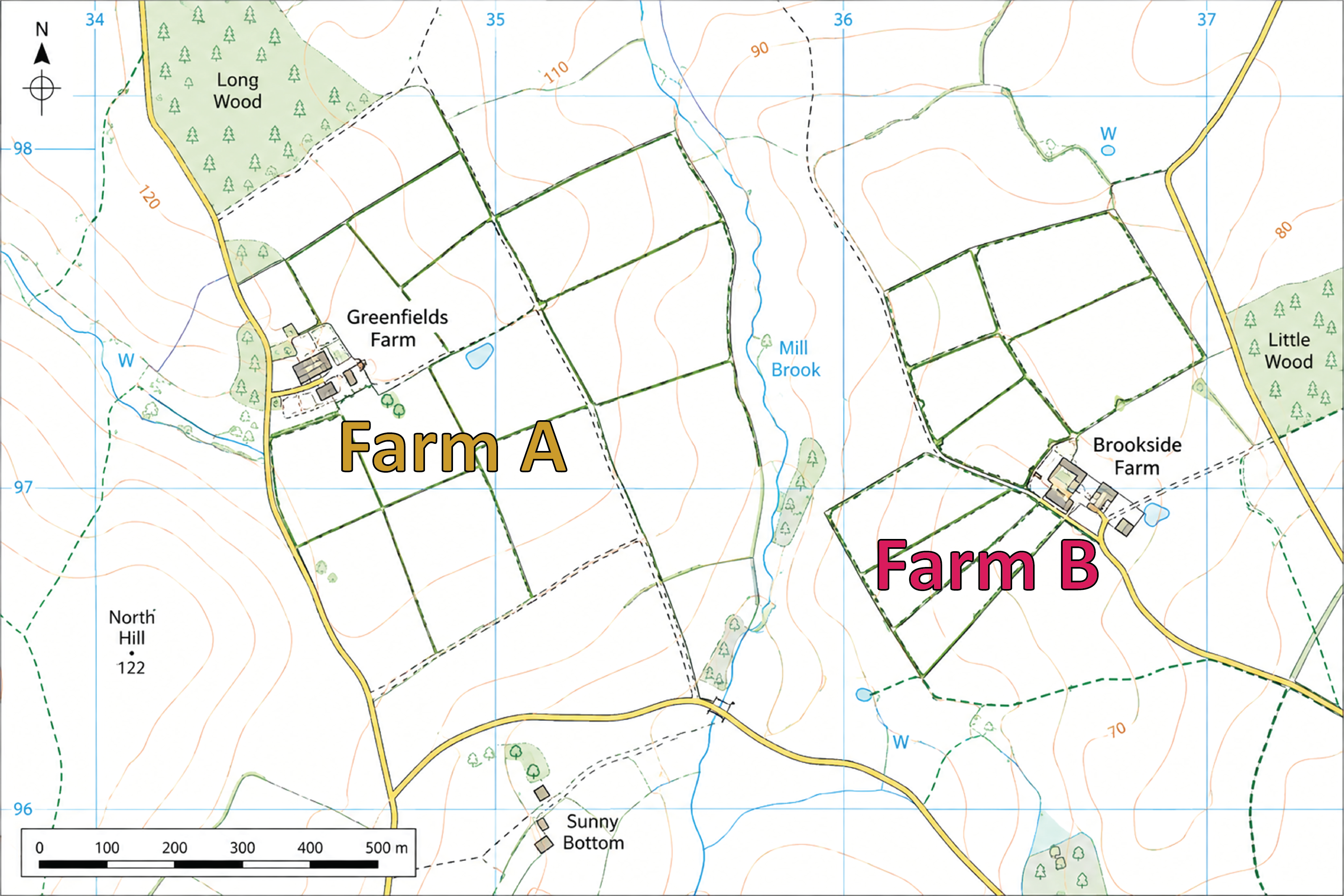
Farm A (Greenfields Farm) uses standard farming practices, and chooses not to use prophylactic antibiotics to aid growth or prevent infection in livestock.
Farm B (Brookside Farm) uses intensive practices (often referred to as “factory farming”), and does use prophylactic antibiotics to aid growth and prevent infection in its livestock.
Sampling Design Details
A surprising number of factors can influence the biological communities in soil (Plassart et al. (2019)) so the two farms were chosen to be matched as closely as possible. We are interested only in the relative effects of whether using or not using prophylactic antibiotic treatments, such that we can assume there is no other confounding influence on bacterial counts due to other factors such as:
- Soil type
- Land use
- Hydrology
- Elevation
Here, the two farms are neighbours, of similar size, and share the same soil type. They are equidistant from the local watercourse (Mill Brook), and farm the same combinations of crops and livestock breeds. The farmers are even related to each other. On both farms all fields and trafficked areas are used for livestock in a rotation system, and have been for decades.
Soil samples were taken at random locations across each farm, representative of all fields and trafficked areas.
On the basis of our sampling design, we therefore assume that there is no relevant influence on bacterial community differences between the two farms, other than the use (or non-use) of prophylactic antibiotics.